
Party Wall Agreed Surveyor: Your Complete Guide to Navigating Party Wall Matters in 2025
When construction work affects the boundary between two properties, the stakes are high, emotions can run hot, and legal complexities multiply quickly. Enter the party wall agreed surveyor—a professional who can transform what might become a bitter dispute into a smooth, legally compliant process. Whether you’re planning an extension, excavating near your neighbour’s foundation, or undertaking structural work on a shared wall, understanding the role of a party wall agreed surveyor could save you thousands of pounds and preserve neighbourly relationships.
The Party Wall etc. Act 1996 governs how property owners must handle building work that affects shared structures or boundaries in England and Wales. At the heart of this legislation lies a unique professional role that many homeowners encounter for the first time when planning construction projects. This comprehensive guide explores everything you need to know about party wall agreed surveyors, from their appointment and responsibilities to costs and common challenges.
Key Takeaways
✅ A party wall agreed surveyor is a single impartial professional appointed by both property owners to oversee party wall matters, offering a cost-effective alternative to appointing separate surveyors for each party.
✅ Both neighbours must consent to using an agreed surveyor rather than appointing their own individual surveyors, making cooperation essential for this streamlined approach.
✅ Agreed surveyors must remain completely impartial, acting fairly for both the building owner and adjoining owner while ensuring compliance with the Party Wall Act.
✅ Costs are typically lower with an agreed surveyor compared to appointing two separate surveyors, though the building owner usually bears all reasonable fees regardless of the appointment structure.
✅ The agreed surveyor produces a legally binding Party Wall Award that protects both parties’ interests and provides a framework for resolving any disputes that arise during construction work.
What Is a Party Wall Agreed Surveyor?
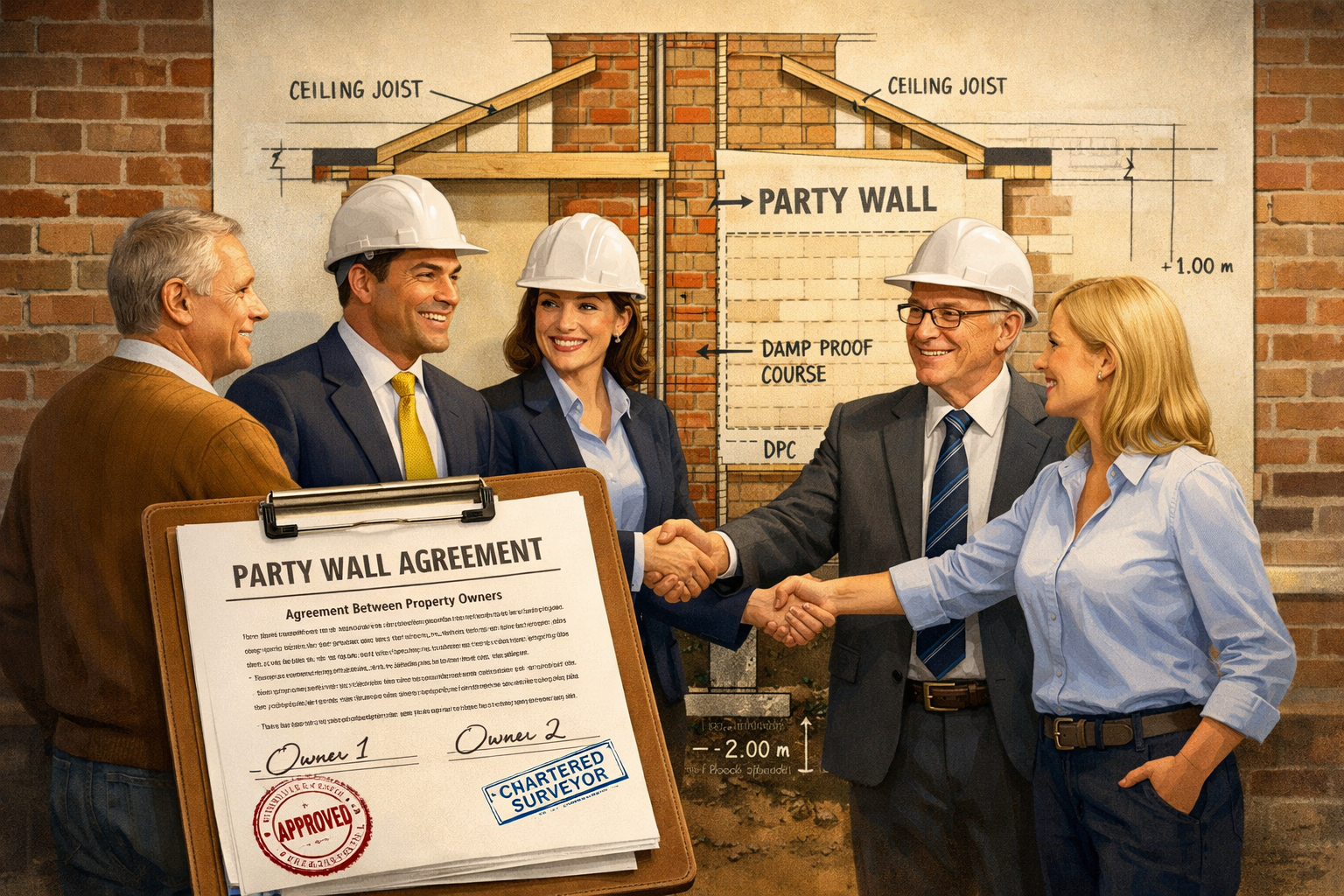
A party wall agreed surveyor is a qualified professional appointed jointly by both the building owner (the person undertaking construction work) and the adjoining owner (the neighbour whose property may be affected) to oversee party wall matters under the Party Wall etc. Act 1996. This appointment represents a collaborative approach where both parties trust a single surveyor to act impartially and protect everyone’s interests.
The concept of an agreed surveyor differs fundamentally from the alternative arrangement where each party appoints their own surveyor. When property owners choose the agreed surveyor route, they’re essentially saying: “We trust this one professional to be fair to both of us and handle this matter efficiently.”
The Legal Framework
The Party Wall etc. Act 1996 provides three options for surveyor appointments:
- Agreed Surveyor: One surveyor appointed jointly by both parties
- Two Surveyors: Each party appoints their own surveyor
- Three Surveyors: Each party appoints a surveyor, and those two surveyors appoint a third surveyor to resolve disputes
The agreed surveyor option streamlines the process considerably, reducing administrative burden and typically lowering costs for all involved. However, this approach requires mutual agreement and trust between neighbours—something that isn’t always present when construction disputes arise.
Key Responsibilities
A party wall agreed surveyor carries significant responsibilities to both parties:
- Inspecting properties before, during, and after construction work
- Preparing detailed condition schedules documenting the current state of both properties
- Drafting the Party Wall Award, a legally binding document outlining how work will proceed
- Ensuring compliance with the Party Wall Act throughout the construction process
- Resolving disputes that arise during the work
- Maintaining impartiality while protecting both parties’ legal rights and property interests
The party wall services provided by qualified professionals ensure that all statutory requirements are met while facilitating good neighbour relations.
When Do You Need a Party Wall Agreed Surveyor?
Understanding when to appoint a party wall agreed surveyor requires knowledge of which building projects trigger the Party Wall Act. Not every construction project requires this formal process, but many common residential improvements do.
Types of Work Requiring Party Wall Procedures
The Party Wall etc. Act 1996 applies to three main categories of work:
1. Work Directly to an Existing Party Wall or Party Structure 🏗️
This includes:
- Cutting into a party wall to insert beams or damp-proof courses
- Raising a party wall for an extension or loft conversion
- Demolishing and rebuilding a party wall
- Underpinning a party wall
- Installing flashings or weatherproofing on a party wall
2. Building a New Wall at or Astride the Boundary Line
This applies when:
- Constructing a new wall exactly on the property boundary
- Building a wall that straddles the boundary line between properties
3. Excavation Within Three or Six Metres of a Neighbouring Building
Excavation work requires party wall procedures when:
- Digging within three metres of a neighbouring structure and going deeper than its foundations
- Excavating within six metres of a neighbouring building and going deeper than a line drawn at 45 degrees from the bottom of the neighbour’s foundations
Common Residential Projects
Homeowners most frequently encounter party wall requirements during:
- Loft conversions that require raising or cutting into party walls
- Basement excavations that extend below neighbouring foundations
- Rear or side extensions affecting party walls or requiring excavation
- Structural alterations to semi-detached or terraced properties
- Boundary wall construction for new developments
Professional chartered surveyors can assess your specific project and determine whether party wall procedures apply, ensuring you remain compliant with legal requirements from the outset.
The Appointment Process for a Party Wall Agreed Surveyor
Appointing a party wall agreed surveyor involves a specific sequence of steps governed by the Party Wall Act. Understanding this process helps property owners navigate what can initially seem like bureaucratic complexity.
Step 1: Serving Party Wall Notices
Before any surveyor appointment occurs, the building owner must serve formal written notice on all affected adjoining owners. The notice must include:
- Detailed description of the proposed work
- Drawings and plans showing the scope of construction
- Proposed start date for the work
- Statement of rights explaining the adjoining owner’s options under the Act
The notice period varies depending on work type:
- Two months for work directly to a party wall or party structure
- One month for excavation work near neighbouring buildings
Step 2: Neighbour’s Response Options
Upon receiving a party wall notice, the adjoining owner has three options:
- Consent to the work (ending the party wall process)
- Dissent or fail to respond within 14 days (triggering the dispute resolution process)
- Propose an agreed surveyor to handle the matter jointly
If the adjoining owner consents without conditions, no surveyor appointment is necessary. However, most construction professionals recommend proceeding with a surveyor and Party Wall Award regardless, as this provides crucial protection if damage occurs.
Step 3: Mutual Agreement on the Surveyor
For an agreed surveyor appointment to proceed, both parties must explicitly agree on the same professional. This agreement should be documented in writing and include:
- The surveyor’s full name and contact details
- Confirmation that both parties consent to this appointment
- Acknowledgment of the surveyor’s duty to remain impartial
- Agreement on fee arrangements (though legally the building owner pays)
Step 4: Formal Appointment
Once both parties agree, the surveyor formally accepts the appointment in writing. This acceptance creates a legal relationship with specific duties and obligations under the Party Wall Act.
The surveyor should provide:
- Written confirmation of appointment
- Fee estimate or schedule of charges
- Timeline for the surveyor’s work
- Contact information for queries from either party
Step 5: Commencement of Surveyor’s Duties
With the appointment confirmed, the agreed surveyor begins work:
- Initial property inspections of both the building owner’s and adjoining owner’s properties
- Preparation of condition schedules with photographs documenting existing conditions
- Drafting the Party Wall Award outlining how work will proceed
- Serving the Award on both parties (who have 14 days to appeal)
Understanding surveyor pricing helps property owners budget appropriately for this essential professional service.
Duties and Responsibilities of a Party Wall Agreed Surveyor
The role of a party wall agreed surveyor carries significant legal and ethical responsibilities. Unlike surveyors appointed by individual parties, the agreed surveyor must maintain perfect balance between competing interests while ensuring statutory compliance.
Impartiality: The Core Principle ⚖️
Impartiality stands as the fundamental duty of any agreed surveyor. This professional must:
- Avoid favouring either the building owner or adjoining owner
- Make decisions based solely on technical merit and legal requirements
- Disclose any potential conflicts of interest before accepting appointment
- Resist pressure from either party to compromise fairness
- Maintain professional independence throughout the process
This impartiality requirement distinguishes agreed surveyors from solicitors or advocates who represent one party’s interests. The agreed surveyor serves the process and the law, not individual clients.
Pre-Construction Responsibilities
Before construction begins, the agreed surveyor must:
Conduct Thorough Inspections
Detailed inspections of both properties establish baseline conditions:
- Photographing all areas potentially affected by construction
- Noting existing cracks, settlement, or structural issues
- Documenting the condition of decorations, finishes, and fixtures
- Identifying vulnerable areas requiring special protection
Prepare Comprehensive Condition Schedules
These schedules serve as crucial evidence if disputes arise later:
- Room-by-room documentation with photographs
- Detailed descriptions of existing defects
- Measurements and technical observations
- Dated and signed records shared with both parties
Draft the Party Wall Award
This legally binding document must include:
- Description of the proposed work
- How and when work will be executed
- Measures to minimize inconvenience and damage
- Rights of access for inspections
- Dispute resolution procedures
- Any special conditions protecting the adjoining owner’s property
During Construction Responsibilities
While work proceeds, the agreed surveyor:
- Monitors compliance with the Party Wall Award conditions
- Conducts periodic inspections to check for damage or deviation from approved plans
- Responds to concerns raised by either party
- Mediates disputes that arise during construction
- Ensures proper working methods that protect neighbouring properties
- Documents the construction process with photographs and notes
Post-Construction Responsibilities
After work concludes:
- Final inspections comparing property condition to pre-construction schedules
- Identifying any damage caused by the construction work
- Recommending remedial work if damage has occurred
- Overseeing repairs to ensure proper restoration
- Issuing completion certificates when all obligations are fulfilled
- Resolving final disputes about damage claims or repair quality
The agreed surveyor’s work doesn’t end when construction stops—it continues until all parties agree that obligations under the Award have been satisfied.
Advantages of Using a Party Wall Agreed Surveyor
Choosing the agreed surveyor route offers several compelling benefits compared to each party appointing separate surveyors. Understanding these advantages helps property owners make informed decisions about their party wall approach.
Cost Efficiency 💰
Financial savings represent the most obvious advantage of appointing an agreed surveyor:
| Appointment Type | Typical Cost Range | Who Pays |
|---|---|---|
| Agreed Surveyor | £700 – £1,500 | Building owner |
| Two Separate Surveyors | £1,400 – £3,000+ | Building owner (both surveyors’ fees) |
| Three Surveyors | £2,100 – £4,500+ | Building owner (all three surveyors’ fees) |
Note: Costs vary significantly based on project complexity, property location, and surveyor experience.
With an agreed surveyor, the building owner pays one professional instead of two or three, potentially halving the surveyor costs. Even though the building owner typically bears all reasonable surveyor fees regardless of appointment structure, the total amount is substantially lower with a single agreed surveyor.
Faster Process ⏱️
Streamlined communication and decision-making accelerate the entire party wall process:
- Single point of contact eliminates coordination delays between multiple surveyors
- Quicker Award preparation without negotiation between opposing surveyors
- Faster dispute resolution when one impartial professional makes decisions
- Reduced administrative burden with simplified correspondence and documentation
Projects can often proceed weeks earlier with an agreed surveyor compared to the two-surveyor approach, which may involve extended negotiations between professionals representing opposing interests.
Simplified Communication
Managing relationships with one surveyor rather than multiple professionals offers practical benefits:
- Clearer lines of communication for both parties
- Consistent information from a single authoritative source
- Reduced confusion about procedures and requirements
- Single schedule for inspections and meetings
- Unified documentation without conflicting reports
Reduced Adversarial Tension
The agreed surveyor approach can help maintain better neighbour relations:
- Signals cooperative intent from the outset
- Reduces “us versus them” mentality that separate surveyors can create
- Encourages collaborative problem-solving rather than positional bargaining
- Minimizes confrontational dynamics during an already stressful process
When neighbours jointly select a trusted professional, it establishes a foundation of mutual respect that can prevent minor disagreements from escalating into serious disputes.
Professional Expertise Without Duplication
An experienced agreed surveyor brings comprehensive knowledge without redundancy:
- Deep understanding of party wall legislation and case law
- Technical expertise in construction methods and structural issues
- Dispute resolution skills honed through numerous party wall matters
- Local market knowledge about typical practices and reasonable costs
- Established relationships with contractors and other professionals
Rather than paying two surveyors to duplicate the same analysis, the agreed surveyor approach channels resources into one highly qualified professional.
For property owners seeking comprehensive guidance on various surveying matters, exploring different survey types can provide valuable context for understanding professional surveying services.
Potential Disadvantages and When to Avoid Agreed Surveyors
Despite the numerous advantages, the agreed surveyor approach isn’t appropriate for every situation. Understanding the limitations and potential drawbacks helps property owners make informed decisions about surveyor appointments.
When Relationships Are Already Strained 😟
If relations between neighbours have already deteriorated, appointing an agreed surveyor may prove difficult or inadvisable:
- Lack of trust makes mutual agreement on a surveyor unlikely
- Suspicion of bias may arise regardless of the surveyor’s impartiality
- Communication breakdown prevents the cooperation necessary for joint appointment
- History of disputes suggests adversarial positions requiring separate representation
In these circumstances, each party appointing their own surveyor may better protect individual interests and provide psychological comfort, even at higher cost.
Complex or High-Value Projects
Certain projects may warrant the additional scrutiny of separate surveyors:
- Major structural work with significant risk of damage
- High-value properties where potential damage claims could be substantial
- Technically complex projects requiring specialized expertise
- Commercial properties with business interruption concerns
- Multiple adjoining properties creating complicated stakeholder dynamics
For particularly complex situations, the three-surveyor approach—where each party’s surveyor appoints a third surveyor—may provide the most robust framework for dispute resolution.
Perception of Bias
Even with the best intentions, perception challenges can arise:
- Prior relationship between the surveyor and one party may create appearance of bias
- Recommendation from one party might make the other party suspicious
- Communication imbalance if one party contacts the surveyor more frequently
- Decision outcomes that favour one party may be questioned
These perception issues can undermine confidence in the process, even when the surveyor acts with complete impartiality.
Limited Advocacy
An agreed surveyor’s impartiality means neither party receives dedicated advocacy:
- No one exclusively protecting your specific interests
- Balanced decisions that may not maximize your preferred outcomes
- Compromise solutions rather than positions favouring one party
- No strategic advice about negotiating tactics or leverage
Property owners who want a professional exclusively focused on their interests should appoint their own surveyor rather than agreeing to a joint appointment.
Difficulty Finding Mutual Agreement
Sometimes the practical challenge of selecting an agreed surveyor proves insurmountable:
- Different preferences for surveyor qualifications or experience
- Geographic considerations about local knowledge versus broader expertise
- Fee concerns if parties disagree about reasonable costs
- Timeline pressures when quick agreement proves elusive
If parties cannot agree on a surveyor within a reasonable timeframe, the dispute resolution process requires each party to appoint their own surveyor anyway.
How to Choose the Right Party Wall Agreed Surveyor
Selecting an appropriate agreed surveyor requires careful consideration of qualifications, experience, and interpersonal factors. Both parties should participate in this evaluation to ensure mutual confidence in the appointment.
Essential Qualifications and Credentials 🎓
Look for surveyors with:
Professional Memberships
- RICS (Royal Institution of Chartered Surveyors) membership, ideally at MRICS or FRICS level
- FPWS (Faculty of Party Wall Surveyors) membership demonstrating specialized expertise
- Pyramus & Thisbe Club membership indicating active engagement with party wall professionals
Relevant Experience
- Minimum 5+ years handling party wall matters
- Dozens of completed Awards demonstrating practical experience
- Experience with similar project types to your proposed work
- Knowledge of local building practices and typical construction methods
Professional Indemnity Insurance
- Adequate coverage (typically £1-5 million minimum)
- Current policy with reputable insurer
- Coverage specifically including party wall work
Key Questions to Ask Potential Agreed Surveyors
Before appointing an agreed surveyor, both parties should ask:
- How many party wall matters have you handled?
- Look for substantial experience (50+ matters minimum)
- What percentage of your work involves party wall matters?
- Specialists who focus primarily on party wall work bring deeper expertise
- Have you handled similar projects to ours?
- Relevant experience with comparable work types ensures appropriate expertise
- What is your fee structure?
- Clear, transparent pricing prevents later disputes about costs
- What is your typical timeline for preparing an Award?
- Realistic expectations about timing help with project planning
- Can you provide references from recent clients?
- Speaking with previous clients offers valuable insights
- Do you have any conflicts of interest?
- Full disclosure ensures genuine impartiality
- How do you handle disputes between parties?
- Understanding their approach to conflict resolution reveals working style
Red Flags to Avoid 🚩
Be cautious of surveyors who:
- Lack specific party wall experience or rely primarily on other surveying work
- Cannot provide clear fee estimates or are evasive about costs
- Show bias toward one party during initial discussions
- Lack professional indemnity insurance or have inadequate coverage
- Make unrealistic promises about outcomes or timelines
- Have poor communication skills or fail to return calls promptly
- Pressure you to make quick decisions without proper consideration
Getting Recommendations
Identify potential agreed surveyors through:
- Professional directories such as the RICS Find a Surveyor tool
- Faculty of Party Wall Surveyors member directory
- Local construction professionals including architects and builders
- Solicitors specializing in property law who regularly work with party wall matters
- Online reviews and testimonials (while considering their limitations)
For comprehensive surveying services beyond party wall matters, established firms like Canterbury Surveyors offer integrated expertise across multiple surveying disciplines.
The Selection Process
An effective selection process involves:
- Both parties independently researching potential surveyors
- Creating a shortlist of 2-4 candidates acceptable to both parties
- Conducting joint interviews (in person or by phone) with top candidates
- Comparing qualifications, experience, and fees objectively
- Checking references from previous clients
- Making a mutual decision both parties can support confidently
This collaborative approach to selection builds confidence in the eventual appointment and establishes positive momentum for the party wall process.
Understanding Costs: What to Expect When Appointing a Party Wall Agreed Surveyor
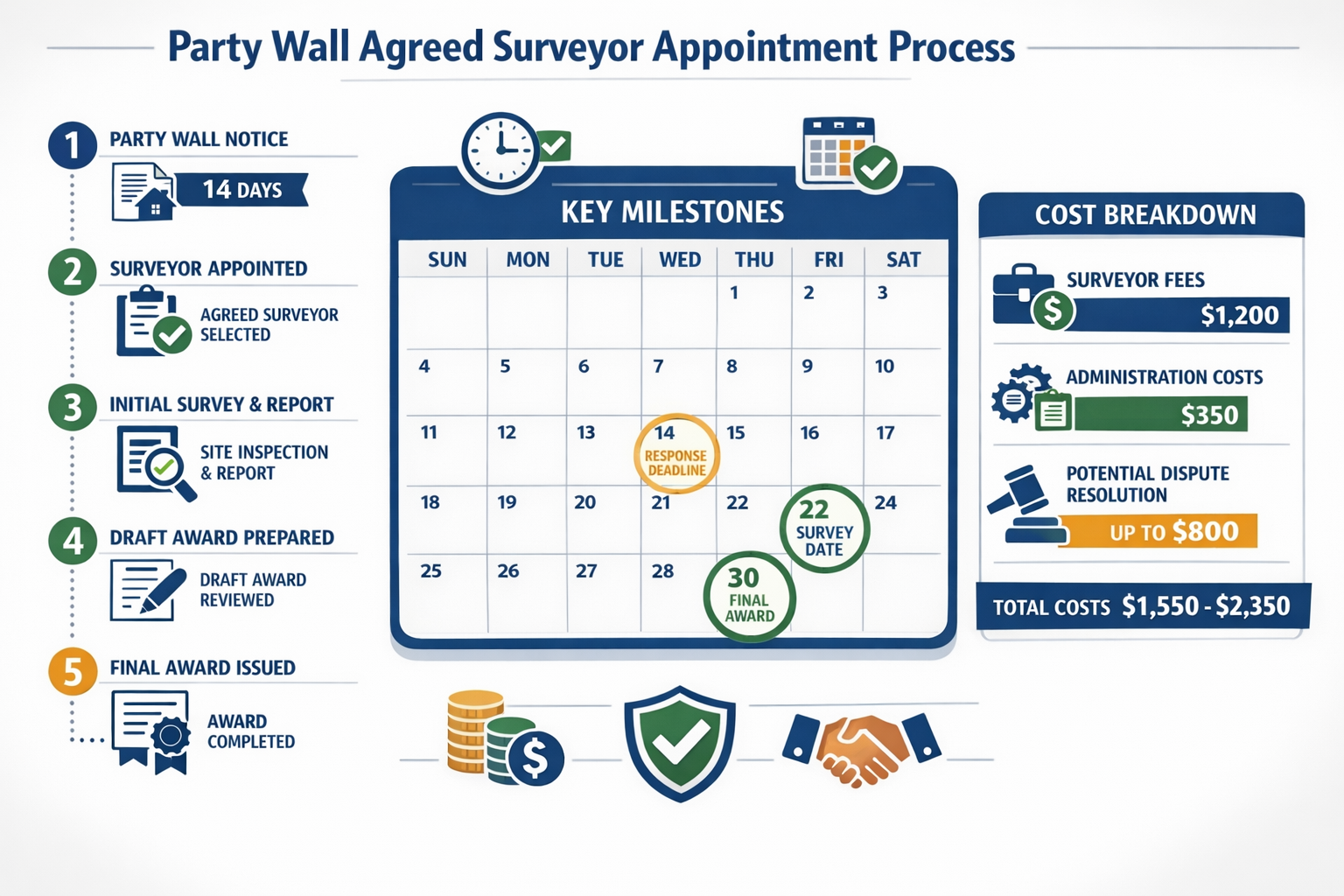
Party wall surveyor fees represent a significant consideration for building owners, who bear responsibility for all reasonable costs under the Party Wall Act. Understanding typical fee structures and cost drivers helps with budgeting and prevents unpleasant surprises.
Typical Fee Structures
Party wall agreed surveyors generally charge using one of three approaches:
1. Fixed Fees
Many surveyors offer fixed-fee packages for straightforward matters:
- Predictable costs known upfront
- Suitable for simple projects with clear scope
- Typically range from £700-£1,500 for basic residential work
- May include limitations on inspection visits or correspondence
2. Hourly Rates
Some surveyors charge based on time spent:
- Hourly rates typically £100-£250 depending on surveyor seniority and location
- More flexible for complex or unpredictable matters
- Requires careful monitoring to control costs
- May include estimates of total hours expected
3. Hybrid Approaches
Many surveyors combine elements:
- Fixed fee for core services (inspections, Award preparation)
- Hourly rates for additional work (dispute resolution, extra visits)
- Balances predictability with flexibility
Cost Factors and Variables
Several factors influence total party wall surveyor costs:
Project Complexity 🏗️
- Simple loft conversion affecting party wall: £700-£1,200
- Rear extension with excavation: £1,000-£1,800
- Basement excavation affecting multiple neighbours: £1,500-£3,000+
- Major structural work or commercial projects: £2,500-£5,000+
Number of Adjoining Owners
- Each additional affected neighbour increases costs
- Separate Awards may be required for each adjoining property
- Multiple inspections and condition schedules multiply work
Geographic Location
- London and Southeast England: Higher fees reflecting market rates
- Regional variations: Typically 20-40% lower outside major cities
- Travel time and expenses for properties in remote areas
Property Type and Value
- Larger, more valuable properties require more detailed documentation
- Listed buildings or conservation areas need specialized knowledge
- Commercial properties involve additional complexity
Dispute Complexity
- Cooperative neighbours minimize surveyor time
- Contentious matters requiring extensive negotiation increase costs
- Damage claims and remedial work supervision add fees
Additional Costs to Consider
Beyond the agreed surveyor’s fees, budget for:
- Adjoining owner’s surveyor fees (if they appoint one despite your agreed surveyor proposal)
- Third surveyor fees (if disputes escalate to this level)
- Legal costs (if court proceedings become necessary)
- Damage repairs (if construction causes harm to neighbouring property)
- Expert reports (structural engineers, etc., if complex issues arise)
Who Pays the Surveyor Fees?
Under the Party Wall Act:
✅ The building owner pays all reasonable surveyor fees, including:
- The agreed surveyor’s fees
- The adjoining owner’s surveyor fees (if separately appointed)
- The third surveyor’s fees (if appointed)
This legal requirement means building owners should budget for party wall costs as part of their overall construction budget, typically allocating 1-3% of construction costs for party wall matters.
Getting Value for Money
Maximize value from your agreed surveyor investment by:
- Choosing experienced specialists who work efficiently
- Providing complete information upfront to minimize back-and-forth
- Responding promptly to surveyor requests
- Maintaining good communication with your neighbour to prevent disputes
- Following the Award conditions carefully to avoid additional inspections
Understanding the broader context of structural survey pricing can help property owners appreciate how party wall fees compare to other surveying services.
The Party Wall Award: What It Contains and Why It Matters
The Party Wall Award represents the culmination of the agreed surveyor’s work—a legally binding document that governs how construction will proceed and protects both parties’ interests. Understanding what the Award contains and its legal significance helps property owners appreciate this crucial document.
Essential Components of a Party Wall Award
A comprehensive Party Wall Award typically includes:
1. Preamble and Parties
- Names and addresses of building owner and adjoining owner(s)
- Property addresses affected by the work
- Details of the agreed surveyor’s appointment
- Date of the Award
2. Description of the Works
- Detailed description of proposed construction
- Reference to plans and drawings
- Specific elements affecting the party wall or boundary
- Timeline for commencement and completion
3. Rights and Obligations
- Building owner’s rights to execute the work
- Adjoining owner’s rights to protection and compensation
- Access rights for inspections and work execution
- Notice requirements for work commencement
4. Working Methods and Safeguards 🛡️
- Specific construction methods to be employed
- Protective measures for adjoining property
- Restrictions on working hours or methods
- Requirements for shoring, weatherproofing, or temporary supports
5. Condition Schedule
- Detailed record of pre-construction property conditions
- Photographs documenting existing state
- Identification of pre-existing defects
- Baseline for assessing any damage claims
6. Inspection Provisions
- Schedule of inspections during construction
- Rights of access for surveyor inspections
- Notice requirements for inspection visits
- Procedures if damage is discovered
7. Dispute Resolution Procedures
- Process for raising concerns during work
- Surveyor’s role in resolving disputes
- Timeline for dispute resolution
- Appeal procedures if parties disagree with surveyor decisions
8. Costs and Fees
- Surveyor fee arrangements
- Responsibility for various costs
- Provisions for additional fees if disputes arise
9. Special Conditions
- Project-specific requirements
- Additional protections for vulnerable structures
- Seasonal or timing restrictions
- Insurance requirements
Legal Status and Enforceability
The Party Wall Award carries significant legal weight:
✅ Legally binding on both parties once served (subject to appeal period)
✅ Enforceable through county court if either party breaches its terms
✅ Survives property transfer, binding future owners if work extends beyond sale
✅ Provides legal framework for damage claims and remediation
✅ Supersedes informal agreements between parties
The Award Service and Appeal Process
After preparing the Award, the agreed surveyor:
- Serves the Award on both parties simultaneously
- Allows 14 days for either party to appeal to the county court
- Answers questions about Award provisions during appeal period
- Becomes binding if no appeal is filed within 14 days
Appeals are relatively rare and typically based on:
- Procedural irregularities in the Award process
- Unreasonable conditions or requirements
- Bias or failure of impartiality by the surveyor
- Legal errors in interpreting the Party Wall Act
Why the Award Matters
The Party Wall Award serves critical functions:
Provides Legal Protection 🛡️
- Documents agreed procedures before disputes arise
- Establishes baseline conditions for damage assessment
- Creates enforceable framework if problems occur
Prevents Misunderstandings
- Clarifies expectations for both parties
- Specifies exactly what work is permitted
- Defines responsibilities clearly
Facilitates Construction
- Gives building owner legal right to proceed
- Provides contractors with clear guidance
- Reduces risk of neighbour objections stopping work
Protects Property Values
- Ensures proper construction methods
- Provides recourse if damage occurs
- Documents professional oversight
For property owners navigating various aspects of property ownership, understanding consent for party wall work provides additional context for the Award’s role in the broader legal framework.
Common Challenges and How Agreed Surveyors Address Them
Even with an experienced agreed surveyor managing the process, party wall matters frequently encounter challenges. Understanding common issues and how surveyors address them prepares property owners for potential complications.
Challenge 1: Neighbour Refuses to Engage 🚫
The Problem:
Adjoining owners sometimes ignore party wall notices, refuse to respond, or actively obstruct the process.
How Agreed Surveyors Address It:
- Under the Party Wall Act, non-response constitutes dissent, triggering the dispute resolution process
- The agreed surveyor can be appointed by the building owner on behalf of a non-responsive adjoining owner
- The surveyor must still act impartially despite one-sided appointment
- Formal service of documents ensures legal compliance even without cooperation
Best Practices:
- Document all communication attempts meticulously
- Use formal service methods (registered post, hand delivery with witness)
- Allow agreed surveyor to manage difficult communication
- Remain patient—the Act provides mechanisms for non-cooperation
Challenge 2: Disagreement About Existing Damage
The Problem:
Parties dispute whether cracks or defects existed before work commenced or resulted from construction.
How Agreed Surveyors Address It:
- Comprehensive pre-construction condition schedules with detailed photographs provide objective evidence
- Time-stamped documentation establishes clear baseline
- Regular monitoring inspections during work track any changes
- Expert structural analysis distinguishes pre-existing settlement from new damage
Best Practices:
- Ensure condition schedule is thorough before work begins
- Don’t rush the initial inspection process
- Raise concerns about schedule accuracy immediately
- Maintain your own photographic record as backup
Challenge 3: Scope Creep and Work Variations
The Problem:
Construction projects often evolve, with changes to original plans that may affect party wall implications.
How Agreed Surveyors Address It:
- Supplemental Awards can be prepared for significant variations
- Regular site inspections identify unauthorized deviations
- Clear communication channels allow quick resolution of minor changes
- Enforcement provisions in original Award provide leverage
Best Practices:
- Notify agreed surveyor immediately of any plan changes
- Don’t assume variations are automatically acceptable
- Ensure contractor understands Award requirements
- Budget for potential supplemental Award costs
Challenge 4: Access Disputes 🚪
The Problem:
Building work may require access to neighbouring property for scaffolding, inspections, or work execution, which neighbours sometimes refuse.
How Agreed Surveyors Address It:
- Party Wall Awards can grant reasonable access rights
- Specific provisions outline notice requirements and access timing
- Surveyor mediates disputes about what constitutes “reasonable”
- Legal remedies available if access unreasonably refused
Best Practices:
- Provide maximum notice for access requirements
- Be flexible about timing to accommodate neighbour’s schedule
- Minimize disruption and duration of access
- Consider alternative construction methods if access proves problematic
Challenge 5: Damage Claims and Remediation Disputes
The Problem:
When damage occurs, parties often disagree about cause, extent, or appropriate remediation.
How Agreed Surveyors Address It:
- Reference to condition schedule establishes pre-work state
- Technical expertise identifies likely cause of damage
- Specification of appropriate remedial works
- Oversight of repair work to ensure proper completion
- Independent expert reports if complex structural issues arise
Best Practices:
- Report potential damage immediately
- Allow surveyor to inspect before undertaking repairs
- Follow surveyor’s remediation specifications
- Document repair work with photographs
- Obtain surveyor’s confirmation of satisfactory completion
Challenge 6: Cost Disputes
The Problem:
Building owners sometimes challenge surveyor fees as unreasonable or excessive.
How Agreed Surveyors Address It:
- Transparent fee agreements established upfront
- Itemized invoices showing work performed
- Comparison to market rates for similar work
- Detailed time records for hourly billing
- County court determination if parties cannot agree
Best Practices:
- Obtain fee estimates before appointment
- Clarify what’s included in fixed fees
- Question unexpected charges promptly
- Keep communication efficient to minimize time-based fees
Understanding how to address damage to property in party wall situations provides additional guidance for one of the most common party wall challenges.
Agreed Surveyor vs. Separate Surveyors: Making the Right Choice
Property owners facing party wall procedures must decide between appointing an agreed surveyor or having each party appoint separate surveyors. This decision significantly impacts costs, timelines, and the overall process experience.
Side-by-Side Comparison
| Factor | Agreed Surveyor | Separate Surveyors |
|---|---|---|
| Cost | £700-£1,500 typically | £1,400-£3,000+ typically |
| Timeline | Faster (2-6 weeks for Award) | Slower (4-12 weeks for Award) |
| Complexity | Simpler, single point of contact | More complex coordination |
| Advocacy | Impartial, no advocacy for either party | Each party has dedicated advocate |
| Neighbour Relations | Signals cooperation | May increase adversarial tension |
| Suitable When | Relations are reasonable, work is straightforward | Relations are poor, complex issues exist |
| Decision Making | Single surveyor decides | Two surveyors negotiate; third surveyor resolves disputes |
| Appeal Risk | Moderate | Lower (balanced representation) |
When Agreed Surveyor Is the Best Choice ✅
Choose the agreed surveyor route when:
- Neighbour relations are reasonable and both parties can cooperate
- Project is relatively straightforward without unusual complications
- Cost efficiency is important to the building owner
- Quick resolution is desired to avoid construction delays
- Both parties trust the same professional’s impartiality
- Risk of damage is low to moderate
- Communication channels between neighbours function adequately
When Separate Surveyors Make More Sense
Appoint separate surveyors when:
- Relations are already strained or hostile
- Project is highly complex with significant damage risk
- Property values are very high justifying additional professional costs
- Technical disputes require detailed advocacy
- One party wants dedicated representation and psychological comfort
- Previous disputes suggest adversarial positions
- Commercial properties are involved with business implications
The Three-Surveyor Scenario
In rare cases, the three-surveyor approach becomes necessary:
How It Works:
- Each party appoints their own surveyor
- Those two surveyors jointly appoint a third surveyor
- If the two surveyors disagree on any matter, the third surveyor makes the final decision
- The third surveyor typically only becomes actively involved when disputes arise
When It’s Used:
- Highly contentious matters with entrenched positions
- Complex technical issues requiring specialist expertise
- High-value properties with major financial stakes
- Previous failed attempts at resolution
Cost Implications:
- Building owner pays all three surveyors
- Costs can reach £3,000-£5,000+ for complex matters
- Third surveyor may charge premium rates for dispute resolution
Making Your Decision
Consider these steps when deciding on surveyor appointment structure:
- Assess your relationship with your neighbour honestly
- Evaluate project complexity and damage risk
- Consider your budget and cost tolerance
- Discuss options with your neighbour early
- Consult with potential surveyors about their recommendation
- Weigh psychological factors—what approach gives you confidence?
Remember that the Party Wall Act allows the adjoining owner to appoint their own surveyor even if the building owner proposes an agreed surveyor. The building owner cannot force the agreed surveyor approach if the neighbour prefers separate representation.
Frequently Asked Questions About Party Wall Agreed Surveyors
Can I appoint my own surveyor as the agreed surveyor?
Technically yes, but this is generally inadvisable. While the Party Wall Act doesn’t prohibit appointing your own surveyor as the agreed surveyor if your neighbour consents, this arrangement creates perception of bias that undermines the process. Most professional surveyors will decline such appointments to maintain clear impartiality. If you have an existing relationship with a surveyor you trust, consider having each party appoint separate surveyors instead.
What happens if we can’t agree on an agreed surveyor?
If you and your neighbour cannot mutually agree on an agreed surveyor, the dispute resolution process requires each party to appoint their own surveyor. The building owner appoints first, then serves notice of this appointment on the adjoining owner, who has 14 days to appoint their own surveyor. If the adjoining owner fails to appoint within this period, the building owner can make the appointment on their behalf.
How long does the party wall process take with an agreed surveyor?
Timeline varies based on project complexity, but typical timeframes include:
- Initial inspection and condition schedule: 1-2 weeks after appointment
- Award preparation: 2-4 weeks after inspection
- Appeal period: 14 days after Award service
- Total from appointment to binding Award: 4-8 weeks typically
Complex projects or uncooperative parties can extend these timeframes significantly.
Can the agreed surveyor be changed mid-process?
Yes, but this is unusual and typically requires consent from both parties or occurs when the surveyor becomes unable to continue (illness, conflict of interest discovered, etc.). Changing surveyors mid-process causes delays and additional costs, as the new surveyor must familiarize themselves with the matter. If serious concerns about surveyor conduct arise, parties can appeal to the county court.
Do I need a party wall agreed surveyor for minor work?
The Party Wall Act applies regardless of work scale—even minor work directly affecting a party wall or involving excavation near foundations triggers the Act’s requirements. However, for very minor work, some surveyors offer streamlined services at reduced fees. The critical factor is whether the work falls within the Act’s scope, not its size or cost.
What qualifications should a party wall agreed surveyor have?
Look for:
- RICS membership (MRICS or FRICS)
- Specialist party wall qualifications (FPWS membership ideal)
- Minimum 5+ years party wall experience
- Professional indemnity insurance (£1-5 million coverage)
- Demonstrated track record with similar projects
Can I dispute the agreed surveyor’s decisions?
Yes, through the appeal process. Either party can appeal the Party Wall Award to the county court within 14 days of service. Appeals must be based on legal or procedural grounds, not simply disagreement with the surveyor’s professional judgment. Court appeals are expensive and time-consuming, so most parties accept Awards even if not entirely satisfied.
What if my neighbour appoints their own surveyor after I propose an agreed surveyor?
This is the adjoining owner’s legal right. If your neighbour appoints their own surveyor, you cannot force the agreed surveyor approach. The process then continues with two separate surveyors, who will work together to prepare the Award. The building owner pays both surveyors’ reasonable fees.
For additional guidance on party wall matters and professional surveying services, the Canterbury Surveyors blog offers valuable resources and insights.
Conclusion: Navigating Party Wall Matters with Confidence
The party wall agreed surveyor represents a cost-effective, efficient approach to managing construction work that affects shared walls and boundaries. When neighbours can cooperate and trust a single impartial professional, this streamlined process saves money, reduces delays, and minimizes adversarial tension that can permanently damage relationships.
However, the agreed surveyor route isn’t universally appropriate. Complex projects, strained neighbour relations, or high-value properties may warrant the additional protection of separate surveyors representing each party’s interests. The key lies in honest assessment of your specific circumstances, open communication with your neighbour, and careful selection of qualified professionals.
Key Principles to Remember
✅ Start early—begin party wall procedures well before construction must commence
✅ Communicate openly with neighbours about your plans and intentions
✅ Choose qualified professionals with specific party wall expertise and proven track records
✅ Document everything through photographs, written correspondence, and formal notices
✅ Follow the Award meticulously to avoid disputes and additional costs
✅ Maintain perspective—party wall procedures protect everyone’s property interests
Your Next Steps
If you’re planning construction work that may trigger party wall requirements:
- Determine whether the Party Wall Act applies to your specific project
- Consult with a qualified surveyor to understand your obligations and options
- Discuss the agreed surveyor approach with your neighbour early
- Research and interview potential agreed surveyors if both parties are willing
- Serve formal party wall notices with proper detail and timing
- Budget appropriately for surveyor fees and potential complications
- Maintain good communication throughout the process
The party wall process may seem bureaucratic and costly, but it serves essential purposes: protecting property rights, preventing disputes, and ensuring construction proceeds safely and legally. An experienced party wall agreed surveyor transforms legal requirements into practical solutions that benefit everyone involved.
Whether you’re planning a modest loft conversion or a major basement excavation, understanding the role and value of party wall agreed surveyors empowers you to make informed decisions, budget accurately, and navigate the process with confidence. The investment in proper party wall procedures pays dividends through legal compliance, damage prevention, and preserved neighbour relations—outcomes that benefit property owners for years beyond construction completion.
For professional guidance tailored to your specific situation, contact experienced chartered surveyors who can assess your project and recommend the most appropriate approach to party wall matters in 2025.